

Navigation menu opened. Press Escape to close.
KALKI
Light for the Dark Age.
Light for the Dark Age.
THE ASHRAM PATH
Eight phases. 54lessons.…
SELF-LEARNING COURSE
The Pathless Path of Bhairava
The most comprehensive Aghora course ever assembled for online study — from first principles to sealed esoteric practices. Eight phases. 54 lessons. A lifetime of practice.
Duration
Phase I: 7 days orientation
Tradition
Aghora / Aghoreshwar / Bhairava / Śaiva
Phases
8 Phases · 54 Lessons
Access Tiers
Lineage
Svacchanda Bhairava → Nāth Siddhas → Kāpālika → Aghorī Sampradāya → Baba Keenaram (c. 1600 CE) → Kinaram Baba → Aghoreshwar Bhagwan Ramji (1937–1991)

Phase I — Praveśa — Entering the Path
Praveśa Mārga
Before a single mantra is chanted, before any ritual is performed, the vessel must be prepared — and the framework understood. This phase strips away every assumption about what Aghora is. You will learn the true etymology (a-ghora = not-terrible), the philosophical core as radical Advaita taken to its logical conclusion, the lineage from Svacchanda Bhairava through Baba Keenaram to Aghoreshwar Bhagwan Ramji, the guru-śiṣya relationship even in self-initiation, and the ethical foundations that prevent the path from becoming egofuel. The Aghori does not worship death — the Aghori has transcended the distinction between life and death, purity and impurity, sacred and profane. This is a lived state, achieved through systematic, staged practice.

Phase II — Deha-Mandira — The Body as Temple
Deha-Mandira Sādhanā
The Aghori does not escape the body — the Aghori uses the body as the primary instrument of awakening. This 40-day intensive begins with the precise daily architecture (Brahma Muhūrta to Sandhyākāla), builds through breath practices that directly affect consciousness, dietary discipline that breaks the deepest patterns of craving, and sensory observation practices that reveal the constructed nature of experience. The body is not an obstacle to liberation — it is the temple in which liberation occurs. But the temple must be cleaned before the deity can be installed.

Phase III — Mantra & Nāda — Sound as Vehicle
Mantra-Nāda-Vidyā
In the Aghori tradition, mantra is not a tool for obtaining desires — it is a method of restructuring consciousness through the precise vibration of Sanskrit syllables. This phase covers the mechanics of japa (repetition), the science of Sanskrit pronunciation (which the tradition insists must be exact), the role of nāda (the inner sound), and the progressive deepening from vocal recitation to mental repetition to the state where the mantra recites itself. The Bhairava mantras are introduced here — not as magic words, but as frequency patterns that dissolve specific layers of the ego.

Phase IV — Yantra & Dṛṣṭi — Sacred Geometry & Concentration
Yantra-Vidyā — The Science of Sacred Instruments
The Yantra is the graphic, mathematical, and magical representation of the divine — an ancient instrument of worship that the Aghori uses as both meditation object and ritual tool. This phase covers the seven categories of yantra, the geometry of the Śrī Yantra (the supreme yantra of Tripurasundarī), the chakra yantras of the subtle body, and the practice of Dṛṣṭi — the concentrated gaze that transforms the yantra from an external object into an internal map of consciousness.

Phase V — Bhairava & Śakti — The Divine Framework
Bhairava-Śakti-Vidyā
Aghora is fundamentally a Bhairava tradition — rooted not in the popular forms of Śiva but in the fierce, transcendent aspect that dwells in the cremation ground, beyond all categories. This phase covers the theology of Bhairava (consciousness as the destroyer of ignorance), the ten Mahāvidyās as karmic-loop archetypes, the symbolism of Śakti as the power of consciousness, and the devotional/contemplative approaches that prepare the practitioner for the direct encounter with the fierce form. This is not deity worship in the conventional sense — it is the recognition that the deity is a map of your own consciousness.

Phase VI — Śmaśāna — Cremation Ground Contemplation
Śmaśāna-Vidyā — The Wisdom of the Burning Ground
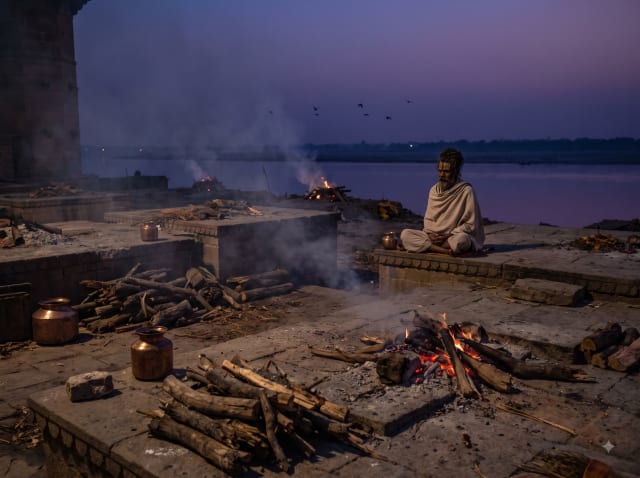
The śmaśāna (cremation ground) is the primary sādhanā-sthāna (practice site) of the Aghori tradition. This is not sensationalism — it is precision. The śmaśāna is where the illusion of permanence is most directly visible, where every human story ends, and where the Aghori practices the most direct form of death-awareness (maraṇa-smṛti). This phase covers the psychology of impermanence, the progressive practice of śmaśāna bhāva (cremation-ground meditation), and the Kapāl Pūjā (skull ritual) as the central Aghori sādhanā. These practices are intense and should only be undertaken after completing Phases I–V.

Phase VII — Aghora as Advaita — The Non-Dual Practice
Aghorādvaita — The Non-Dual State
Aghora is Advaita Vedānta in its most radical, uncompromising, lived form — not "all is one" as an idea, but as a direct experience that transforms every aspect of perception and behavior. This phase covers the practices that produce this experience: the transcending of aversion (the ability to remain present with what the mind rejects), the dissolution of the purity-impurity distinction (the Aghori's most famous and most misunderstood practice), the systematic dismantling of the ego-structure, and the radical acceptance that is the hallmark of the Aghori state. These are the most advanced practices in the course and carry the highest caution level.

Phase VIII — Samāpatti — Integration
Jīvanmukta — Liberation While Living
The final phase is not an endpoint but a beginning — the beginning of living as an Aghori in the world. The paradox of Aghora is that the one who has transcended the world is the one who can most fully participate in it. This phase covers the practice of selfless service (Sevā), the maintenance of daily discipline (Anuṣṭhāna), the discernment between authentic and inauthentic spiritual claims (Viveka), and the integration of all previous practices into a seamless daily life that does not separate "spiritual" from "ordinary." The goal is not to become a professional Aghori — it is to become a fully human being.
READY TO BEGIN
The path is open.
Eight phases. 54 lessons. A lifetime of practice. Speak with Kaustubh before entering the ashram.
Ten Doors · A Free Course
One letter a day from the Archive — evidence-graded, no mythology, unsubscribe anytime.